
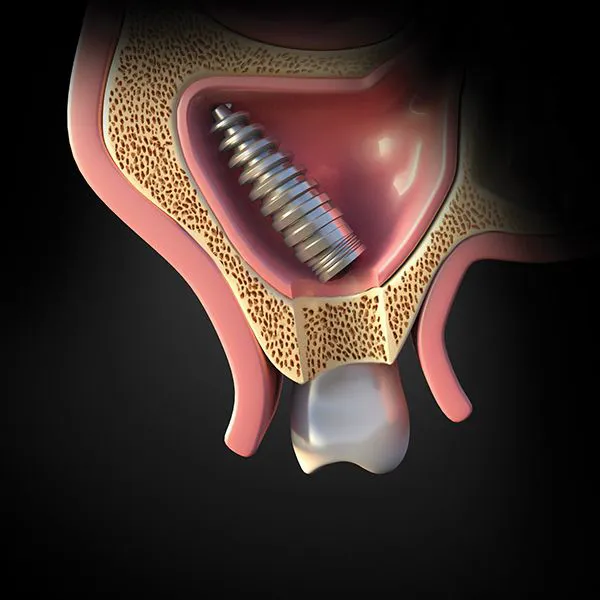

Dental bone grafting in Beverly Hills rebuilds jawbone that has shrunk after tooth loss, gum disease or an old infection, so an implant has solid bone to hold onto. At ConfiDental, Dr. Liyan Massaband measures your bone on a 3D scan and recommends the simplest graft that will do the job, from a socket graft at the time of an extraction to a ridge augmentation or sinus lift. You get a healing timeline and a written cost before anything starts.
Many people never need a graft. The scan tells us which group you are in.
What a dental bone graft is
A bone graft places bone material in the jaw where bone is missing. The material acts as a scaffold. Your body grows new bone into it, and over the following months most of the graft is replaced by your own bone. A thin membrane is often laid over the top to keep gum tissue out while that happens.
Why the jawbone shrinks
Tooth roots stimulate the bone around them every time you chew. When a tooth is lost, that stimulation stops and the bone gradually resorbs, mostly in width at first and then in height. The fastest change happens in the first months after an extraction, which is why grafting the socket on the day the tooth comes out is often the simplest way to protect the site.
Other common causes:
- Gum disease that has destroyed bone around teeth
- A long-standing tooth infection or failed root canal
- Many years of wearing a denture
- A failed implant or an injury to the jaw
- In the upper back jaw, the sinus expanding downward into space left by a lost tooth
Do you need a bone graft?
You may, if:
- A tooth was removed months or years ago and you now want an implant
- You have been told you do not have enough bone for implants
- The gum and jaw look sunken or narrow where a tooth is missing
- Your denture has gradually become looser
- You are having a tooth removed and plan an implant later
- Teeth are loose because gum disease has caused bone loss
You may not, if your scan shows enough height and width. Many patients go straight to dental implants, and small gaps around an implant can often be grafted during the implant visit itself.
Types of bone grafts
| Procedure | What it does | Often used when | Typical healing before an implant |
|---|---|---|---|
| Socket preservation | Fills the socket right after an extraction | A tooth is coming out and an implant is planned | About 3 to 4 months |
| Ridge augmentation | Widens or builds up a thin ridge | A tooth was lost some time ago | About 4 to 6 months |
| Internal sinus lift | Gently raises the sinus floor through the implant site | A little extra height is needed in the upper back jaw | Usually done with the implant |
| Lateral sinus lift | Adds bone under the sinus through a small window | Significant height is missing in the upper back jaw | About 6 to 9 months |
| Guided bone regeneration | Graft plus membrane to regrow a defect | Bone loss around a planned or existing implant | About 4 to 9 months |
| Block graft | A piece of bone fixed in place | Severe bone loss | Referred to an oral surgeon or periodontist |
For severe upper jaw bone loss, options such as zygomatic implants exist. These are placed by oral and maxillofacial surgeons, and we refer you when that is the better route.
What graft material is made of
| Material | Source | Notes |
|---|---|---|
| Autograft | Your own bone, usually from the jaw | Grows bone well but needs a second site |
| Allograft | Screened, sterilized human donor bone | Widely used, no second surgical site |
| Xenograft | Processed bovine bone mineral | Resorbs slowly, so it holds space well |
| Alloplast | Synthetic materials such as hydroxyapatite | No human or animal origin |
We explain which material we suggest for your site and why. If you prefer to avoid donor or animal-derived material, tell us and we will plan around it.
The bone grafting procedure at our office
Consultation and 3D scan
An exam, X-rays and a 3D CBCT scan show how much bone you have and where the nerves and sinus sit. We plan the graft around the exact position of your future implant, so the bone is built where it will actually be used.
On the day
The area is numbed with local anesthesia, and you feel pressure but not pain. For a socket graft, the material goes straight into the cleaned socket after the tooth is removed. For a ridge graft or sinus lift, the gum is gently opened, the graft is placed and a membrane is laid over it. Stitches hold the gum in place; many dissolve on their own.
Healing checks
We see you after about a week and again as the bone matures. A follow-up scan confirms the bone is ready before your implant goes in. Placing the implant once the graft has healed, rather than waiting indefinitely, helps keep the new bone from shrinking again.
Is a bone graft painful?
During the procedure, no. Most people describe the next few days as sore rather than painful, with swelling peaking on day two or three. Over-the-counter pain relievers are usually enough, and sedation is available if you are anxious about the visit. A sinus lift can also leave the nose feeling stuffy for a few days.
Recovery timeline
| Time after surgery | What to expect |
|---|---|
| Days 1 to 3 | Swelling and soreness peak, some oozing is normal |
| Days 4 to 7 | Swelling eases, most people are back to normal routines |
| Weeks 1 to 2 | Stitches dissolve or come out, the gum surface heals |
| Months 3 to 4 | Socket and small grafts are often ready for an implant |
| Months 6 to 9 | Larger ridge grafts and lateral sinus lifts mature |
Very large grafts can take up to a year.
Aftercare: what to eat and avoid
For the first few days, stick to soft, cool or lukewarm foods such as yogurt, eggs, oatmeal, mashed potatoes and smoothies without a straw. Chew on the other side, use cold packs for the first 24 to 48 hours, and take any medicines exactly as prescribed.
Avoid:
- Straws, forceful spitting and vigorous rinsing for the first few days
- Smoking and vaping, which raise the risk of the graft failing
- Hard, crunchy or sticky foods near the site until we clear it
- Blowing your nose hard after a sinus lift; sneeze with your mouth open
A few small granules of graft material in your mouth in the first days are normal. Call us if bleeding does not stop with pressure, swelling worsens after day three, or you develop fever or pus. Our guide to dry socket explains normal and abnormal healing after an extraction.
Results and risks
Bone grafting is routine and usually successful, but every surgery carries some risk. Infection, part of the graft not taking, temporary numbness from nerve irritation and sinus irritation after a lift are all possible. A small repeat graft fixes most partial failures. Your odds improve if you do not smoke, keep diabetes well controlled, keep the area clean and have any gum disease treated first.
Bone graft cost in Beverly Hills
| Procedure | Typical cost |
|---|---|
| Socket preservation, one tooth | $400 to $1,000 |
| Ridge augmentation, one implant site | $800 to $3,000 |
| Guided bone regeneration with membrane | $1,500 to $3,000 |
| Internal sinus lift, per site | $1,000 to $2,000 |
| Lateral sinus lift, per side | $2,500 to $3,500 |
The size of the defect, the material, whether a membrane is needed and whether the graft is done alongside an extraction or implant all change the figure. Some dental plans cover part of a socket graft or a graft for implants, and medical insurance occasionally helps when bone loss comes from an injury. Our guide to understanding dental insurance explains how this usually works, and CareCredit financing is available.
Bone grafting as part of a bigger plan
A graft is rarely the goal in itself. It is usually one step toward a single implant, an All-on-4 arch or a full mouth restoration, or toward replacing an implant that failed. Bone grafting rebuilds bone. If your gums have receded, that is a separate procedure called gum grafting.
Dr. Massaband plans grafts and implants together and has more than 1,500 implant procedures behind her. For large defects, block grafts or zygomatic implants, she works with periodontists and oral surgeons and will tell you plainly when a referral is the better choice. Patients reach our Brighton Way office easily from Century City and Beverly Grove. Call (310) 858-9212 or book a bone graft consultation online.