
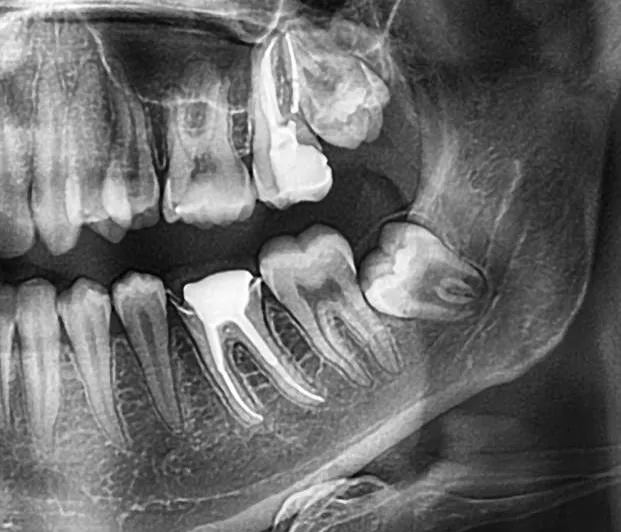

Not every wisdom tooth needs to come out, but one that is impacted and causing pain, infection or damage to the tooth in front of it usually should. Wisdom teeth removal in Beverly Hills at ConfiDental starts with imaging that shows exactly how each tooth sits, so you know whether removal is needed, how involved it will be and what it will cost before anything is booked. Dr. Liyan Massaband removes most impacted and partly erupted wisdom teeth in our office, and refers to an oral surgeon when a tooth sits too close to the nerve or calls for deeper sedation.
Go to the emergency room or call 911 if swelling is spreading down your neck or toward your eye, or you have trouble breathing or swallowing. Fever with jaw swelling, or being able to open your mouth only a little, needs to be seen the same day by an emergency dentist; our facial swelling page explains why.
Do your wisdom teeth need to come out?
Wisdom teeth that come in fully, work well, and are healthy and easy to clean may never need removal, though they still need regular checks and X-rays. Removal is usually recommended when a tooth:
- Keeps causing pain, swelling or gum infection
- Is partly through the gum and traps food and bacteria
- Is pressing on or damaging the second molar
- Has a cavity that cannot be properly repaired
- Has a cyst forming around it
- Is in the way of orthodontic treatment or other dental work
Most wisdom teeth arrive between about 17 and 25. Removal in the late teens or early twenties is often simpler because the roots are not fully formed and healing tends to be quicker, but adults of any age can have them removed safely.
What is an impacted wisdom tooth?
An impacted tooth cannot come in normally, because there is not enough room, it is growing at an angle, or bone or another tooth is in the way.
- Partly erupted: part of the tooth breaks through the gum. The flap of gum over it traps bacteria and often leads to a painful infection called pericoronitis.
- Soft tissue impaction: the tooth is through the bone but still covered by gum.
- Bony impaction: the tooth is partly or fully trapped in the jawbone.
Impacted teeth do not always hurt. Some sit quietly for years, while others damage the second molar, collect decay or gum disease, or occasionally form cysts in the jaw.
| Angle | Position | How involved removal usually is |
|---|---|---|
| Mesial, the most common | Tilted forward toward the second molar | Moderate, depending on angle and bone cover |
| Vertical | Upright but stuck | Often the simplest, unless deep in bone |
| Distal | Tilted backward | Can be harder to reach |
| Horizontal | Lying on its side against the second molar | Most involved, usually removed in sections |
Double and fused wisdom teeth
A double, or fused, wisdom tooth formed from a bud that partly split, so it has an extra-wide crown or two joined crowns. Its unusual shape and roots make removal more involved, so 3D imaging is especially useful. People also say "double impacted" to mean two or more impacted wisdom teeth at once, which is very common.
Symptoms of an impacted wisdom tooth
- Aching at the back of the jaw, sometimes spreading to the ear
- Red, swollen or bleeding gum behind the last molar
- A bad taste or bad breath from the back of the mouth
- Jaw stiffness or difficulty opening wide
- Swelling of the jaw or cheek
- A tooth you can see or feel partly through the gum at the back
What we treat here, and when we refer
Treated in our office:
- Partly erupted and soft tissue impactions
- Most partial bony impactions
- Many full bony and angled impactions, once imaging confirms a safe distance from the nerve
- Two, three or all four teeth in one visit when appropriate
Referred to an oral and maxillofacial surgeon:
- Roots very close to, or wrapped around, the nerve in the lower jaw
- Deep horizontal impactions or teeth close to the sinus
- Patients who need or prefer IV sedation or general anesthesia
- Complex medical histories that call for a surgical or hospital setting
For a tooth very close to the nerve, a surgeon may suggest a coronectomy, which removes the crown and leaves the roots in place to protect the nerve.
Your wisdom tooth removal, step by step
- Exam and imaging Digital X-rays show the position, angle and roots of each tooth, and a 3D cone beam scan is used when a tooth may be close to the nerve.
- Plan and estimate We explain which teeth should come out and why, how each will be removed, your sedation options and the full cost with an insurance estimate.
- Removal Partly erupted teeth usually come out whole. Teeth deeper in bone are gently divided into sections and removed piece by piece, which protects the bone and the neighboring molar. Dissolving stitches are placed if needed. Our surgical extractions page describes the technique in more detail.
- Follow-up You go home with written aftercare and a number to call, and we usually check healing at about one week.
If you are planning an implant elsewhere in the mouth, or a back molar is coming out at the same time, ask whether socket preservation makes sense for that site.
Comfort and sedation
Every extraction is done with local anesthetic, so you feel pressure but not pain. You can add nitrous oxide, which relaxes you and wears off quickly so most people can drive home, or oral sedation, a tablet taken before the visit for deeper relaxation, in which case someone needs to drive you. We explain what is happening as we go, and you can stop for a break at any point.
Recovery after wisdom teeth removal
| Time | What to expect | What helps |
|---|---|---|
| First 24 hours | Oozing, numbness wears off, swelling starts | Bite on gauze, ice on the cheek, rest with your head raised |
| Days 2 to 3 | Swelling and stiffness peak | Soft, cool foods, pain relief as directed |
| Days 4 to 7 | Swelling and soreness ease | Gentle warm salt water rinses, soft foods |
| One to two weeks | Gums close over the sockets | Most normal foods return |
| Two to four months | Bone fills the sockets | Nothing special needed |
Protect the blood clot for the first few days: no smoking or vaping, straws, forceful spitting or hard rinsing. Pain that suddenly gets worse around day three to five may be dry socket, which is treatable and usually settles quickly once dressed.
Call us if bleeding will not slow with pressure, swelling keeps growing after day three, you develop fever, pus or a bad taste, or numbness of the lip or chin lasts beyond the next day.
Risks of wisdom tooth removal
Most people recover from wisdom tooth removal within one to two weeks, but every surgery carries risk. Dry socket is the most common problem, and it is more likely with lower teeth and in smokers. Infection, bleeding and stiffness that limits how wide you can open can also occur.
Lower wisdom teeth can sit close to the nerve that gives feeling to the lip and chin. If removal disturbs it, numbness is usually temporary, but in rare cases it lasts longer. Upper wisdom teeth can sit close to the sinus. This is why we image each tooth first and refer to an oral surgeon when a root is too close to the nerve. For a healthy tooth that causes no symptoms, keeping it and checking it at your exams is also a reasonable choice.
Wisdom teeth removal cost in Beverly Hills
| Procedure | Typical cost per tooth |
|---|---|
| Simple extraction, erupted or partly erupted | $200 to $500 |
| Soft tissue impaction | $300 to $600 |
| Partial bony impaction | $450 to $800 |
| Full bony impaction, including horizontal | $600 to $1,200 |
| All four wisdom teeth | $1,500 to $4,500 total |
| Oral sedation, added | $250 to $500 |
| Consultation and X-rays | $100 to $300 |
These are typical ranges, not a quote; you get an itemized estimate before surgery. Most dental plans cover part of wisdom tooth removal under surgical extraction benefits, up to the yearly maximum. Our guide to understanding dental insurance explains how this usually works, and CareCredit financing is available.
Dr. Massaband has removed wisdom teeth, including surgical impactions, for more than 15 years. Patients come to us from Westwood, Brentwood and across the Westside, and painful cases are seen the same day whenever possible. Call (310) 858-9212 or book a wisdom tooth consultation online.