
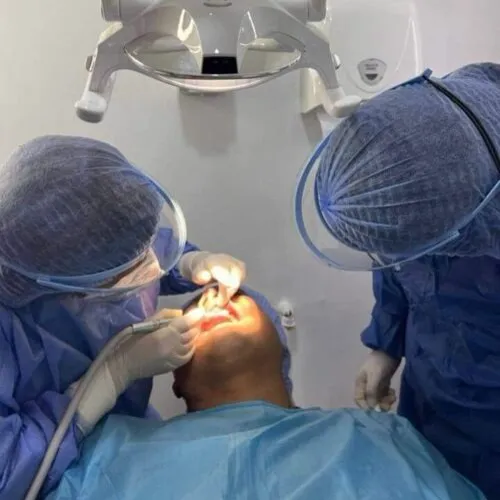

If a tooth is throbbing, lingering after hot or cold, or starting to swell, root canal therapy in Beverly Hills at ConfiDental can stop the pain and keep your natural tooth. We numb the area thoroughly, remove the infected nerve, disinfect and seal the inside of the tooth, then plan the crown that protects it. Most patients tell us afterward that it felt like a long filling, and far better than the toothache that brought them in. When you call with pain or swelling, we do our best to see you the same day.
Swelling in your face or jaw? Call us today, and read about facial swelling. If swelling is spreading fast, or you have trouble breathing or swallowing, go to the nearest emergency room.
What is a root canal?
Inside every tooth is the pulp, a soft core of nerves and blood vessels running down through the roots. When deep decay, a crack or an old injury lets bacteria reach the pulp, it becomes inflamed and then infected. That is the deep, pulsing ache that tends to get worse at night when you lie down.
A root canal, or endodontic treatment, removes that tissue, cleans and disinfects the canals inside the roots, and seals them so bacteria cannot get back in. The tooth stays in place, its roots stay in the bone, and it is usually protected afterward with a crown.
Why antibiotics or waiting will not fix it
A tooth infection does not heal on its own. Antibiotics may calm swelling for a few days, but they cannot reach bacteria living inside a tooth whose blood supply has died. That is why the ADA advises against antibiotics as a substitute for treating the tooth.
Left alone, the infection can form an abscess and spread into the jaw, face and neck. Sometimes the pain even fades because the nerve has died, which people mistake for healing. The infection is still there, and it is still growing.
Signs you may need a root canal
- Throbbing pain, especially at night
- Sensitivity to hot or cold that lingers after the drink is gone
- Pain when you bite or chew
- A tooth that has turned grey or darker than its neighbors
- A swollen gum or a pimple-like bump near the tooth, often a sign of a tooth abscess
- A deep cavity or a cracked tooth that hurts
Some infected teeth cause no pain at all and only show up on an X-ray. Our article on the signs you need a root canal goes into more detail.
How root canal therapy in Beverly Hills works at our office
- Diagnosis An exam, an X-ray and simple tests on the tooth confirm whether the nerve can recover or needs treatment.
- Numbing Infected teeth can be stubborn to numb, so we use additional techniques when needed and test before we start. If you feel more than pressure, we stop and add more.
- Isolation A thin rubber sheet keeps the tooth clean and dry, and keeps instruments and solutions out of your mouth.
- Cleaning and shaping We remove the pulp, shape each canal and flush it with disinfecting solutions.
- Sealing The canals are filled with a biocompatible material and sealed.
- Rebuilding A filling closes the access opening. Most back teeth then need a porcelain crown, because a tooth that has had a root canal is more brittle and more likely to crack under chewing forces.
Most root canals take a single visit of about 60 to 90 minutes. Molars with curved or extra canals, or teeth with a heavy infection, sometimes need two.
Does a root canal hurt?
With good numbing, most patients feel pressure and vibration, not pain. The tooth and gum may be tender for a few days afterward, mostly from the inflammation that was already there. The ADA recommends ibuprofen, alone or with acetaminophen, as the first choice for dental pain if it is safe for you.
If you are anxious, tell us. We explain each step before we do it, agree on a hand signal for breaks and never rush you.
Recovery and aftercare
- Wait until the numbness wears off before eating.
- Chew on the other side until the permanent crown or filling is in place.
- Expect mild tenderness for a few days. Swelling, if any, usually peaks around day two or three.
- Brush and floss normally, gently around the tooth.
- Call us if swelling grows after day three, pain gets worse instead of better, or you develop a fever.
Our article on swelling after a root canal explains what is normal and what is not.
How long does a root canal tooth last?
A well-sealed root canal with a good crown can last many years, often for life. What matters most is the restoration on top. A leaking filling or a cracked crown lets bacteria back into the canals, so we check treated teeth at every exam and keep an eye on them on X-rays.
Risks and success rates
Root canal treatment saves most teeth, but no dental treatment comes with a guarantee, and results vary from tooth to tooth. The main risks are a flare-up of pain or swelling in the first few days, a crack in the root that could not be seen beforehand, a canal that is too narrow or curved to clean fully, and, rarely, a small instrument fragment left inside a canal. A back tooth that is not protected with a crown afterward is much more likely to break.
If a treated tooth does run into trouble, the usual next steps are retreatment, surgery at the root tip or extraction. We explain which one fits your tooth, and why, before anything is done.
Root canal retreatment
Occasionally a treated tooth becomes infected again, usually because of a hidden extra canal, a crack or a crown that has started to leak. Retreatment reopens the tooth, removes the old filling material, cleans the canals again and reseals them.
We see many patients for second opinions on root canals done elsewhere. For complex cases, such as very curved or blocked canals, or when surgery at the root tip is needed, we refer to a trusted endodontist and coordinate your care.
Partial root canal (pulpotomy)
A pulpotomy removes only the infected pulp in the top part of the tooth and keeps the healthy pulp in the roots alive. In children, it is used to keep baby teeth until they fall out naturally. In adults, it can be an option when the nerve has been exposed by an injury or small cavity but is otherwise healthy. For most adult teeth with an established infection, a full root canal remains the standard.
Root canal or extraction?
| Root canal and crown | Extraction | |
|---|---|---|
| Your natural tooth | Saved | Removed |
| Jaw bone | Kept, because the root stays in place | Shrinks over time without a replacement |
| Neighboring teeth | Stay in place | Can drift into the gap |
| Next step | A crown | An implant or bridge to fill the gap |
| Total cost over time | Usually lower | Usually higher once the tooth is replaced |
We recommend saving the tooth whenever it can be restored well. If it cannot, because of a vertical root fracture, too little tooth left or severe bone loss, we will tell you plainly and plan a surgical extraction with a dental implant to follow. For a side-by-side look, read root canal vs. tooth extraction.
Root canal cost
Cost depends mainly on which tooth it is, because molars have more canals and take longer. Typical ranges:
| Tooth | Typical cost | Usual number of canals |
|---|---|---|
| Front tooth (incisor or canine) | $700 to $1,000 | 1 |
| Premolar | $800 to $1,200 | 1 or 2 |
| Molar | $1,000 to $1,500 | 3 or 4 |
| Root canal retreatment | $1,200 to $1,800 | Varies |
| Crown after a root canal | $1,200 to $2,000 | Billed separately |
Most dental plans cover root canals under basic or major services, often at 50 to 80 percent up to your annual maximum, with crowns under a similar benefit. We confirm coverage and give you a written, itemized estimate first. See understanding dental insurance and our payment options.
Your root canal dentist
Dr. Liyan Massaband has more than 15 years of experience. She explains every option before treatment and lets you decide. Patients reach our Brighton Way office easily from Beverlywood and Century City. Call (310) 858-9212 or book a root canal consultation online. After hours, call (818) 875-5417.