
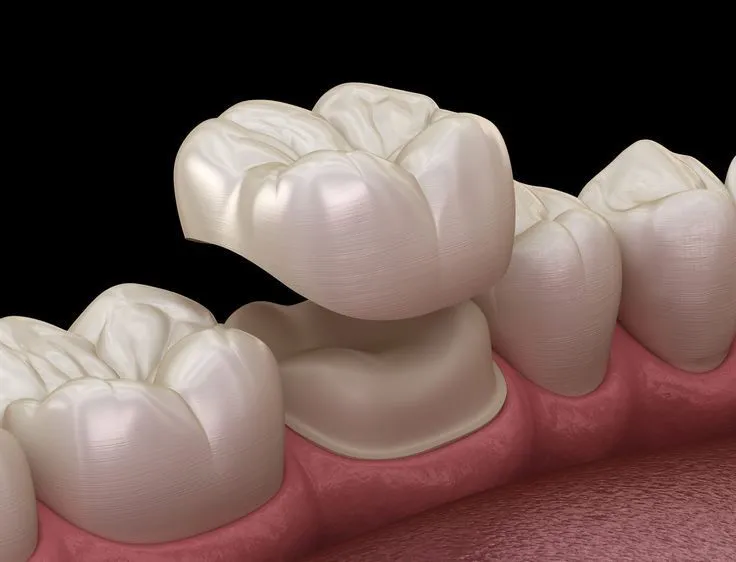

Inlays and onlays are custom porcelain restorations for back teeth that have too much damage for a filling but not enough to need a full crown. They sit in the middle ground. At ConfiDental, we recommend them when they let you keep more of your own tooth than a crown would, while giving you a stronger, longer-lasting repair than a large filling.
Because they are made from tooth-colored ceramic and bonded in place, they also look like natural enamel. Most people cannot tell which tooth was restored.
What are inlays and onlays?
Both are "indirect" restorations. Instead of being shaped in your mouth like a filling, they are made to fit from a precise impression or digital scan, then bonded into the prepared tooth.
- An inlay fits inside the cusps, the raised points on the chewing surface of a back tooth. It fills a cavity or replaces an old filling in the center of the tooth.
- An onlay extends over one or more cusps. It is used when a cusp is cracked, weak or has broken off.
Think of an onlay as a partial crown. It protects the parts of the tooth that need it and leaves healthy enamel alone.
When we recommend an inlay or onlay
They are a good choice when:
- A cavity is too wide or deep for a direct filling to hold up well
- An old, large silver or composite filling is cracking or leaking
- A cusp has fractured but the rest of the tooth is sound
- You want to replace metal fillings with a tooth-colored option on a back tooth
- A crown would mean removing a lot of healthy tooth that does not need covering
If decay has spread across most of the tooth, or the tooth has had a root canal and is brittle, a full porcelain crown is usually the safer option. For a small cavity, a tooth-colored filling is quicker and costs less. Dr. Massaband will explain which option fits your tooth and why.
Are you a good candidate?
Good candidates have a back tooth with moderate damage, healthy gums around it and enough sound tooth left to bond to. Active decay is removed first. If the nerve is inflamed or infected, it needs to be treated before any restoration is placed, which may mean root canal therapy. When damage reaches below the gum line, a short gum procedure called crown lengthening can expose enough tooth to restore it properly.
Heavy grinding is not a deal breaker, but it affects the choice of material and whether you should wear a night guard afterward.
The inlay and onlay procedure
Most inlays and onlays take two visits.
- Exam and X-rays We check the extent of the damage, the health of the nerve and your bite.
- Preparation Under local anesthetic, old filling material and decay are removed and the tooth is shaped. Only damaged or weak tooth structure is taken away.
- Scan A digital scan or impression records the exact shape of the prepared tooth and its neighbors.
- Temporary A temporary restoration protects the tooth while the porcelain piece is made in a dental laboratory.
- Fitting and bonding At the second visit the temporary comes off, the porcelain is tried in, checked for fit, shade and bite, then bonded permanently.
- Polish and bite check We fine-tune the bite so the tooth feels like your own when you chew.
Recovery and aftercare
Once the numbness wears off you can eat normally. Some teeth are a little sensitive to cold or pressure for a few days, which usually settles on its own. If the bite feels high, call us. A quick adjustment fixes it.
Care is the same as for natural teeth: brush twice a day, floss daily, and keep up regular cleanings so we can check the margins where porcelain meets tooth. If you grind your teeth, a night guard protects the restoration.
How long do inlays and onlays last?
Well-made porcelain inlays and onlays are strong and stain resistant, and they commonly last many years, often longer than large composite fillings. Longevity depends on your bite, your habits and how well the edges are kept clean.
Cost and insurance
The cost of an inlay or onlay depends on the size of the restoration and the material used, and usually falls between that of a large filling and a crown. You receive a written, itemized estimate before treatment.
Because inlays and onlays treat decay or damage, dental insurance often covers part of the cost. We welcome PPO plans from major insurers and can check your benefits ahead of time. Our payment options page covers financing.
Risks and alternatives
Inlays and onlays are a routine, predictable treatment, but like any dental work they carry some risks:
- Temporary sensitivity after preparation and bonding
- A small chance that a deep cavity irritates the nerve, which may later need root canal treatment
- Porcelain can chip or crack under very heavy forces
- Decay can return at the margins if the area is not kept clean
The main alternatives are a large direct filling, which is quicker but less durable on a heavily loaded tooth, or a full crown, which offers maximum protection but removes more tooth. Leaving a cracked or leaking filling alone carries its own risk: the tooth can split and need extraction. Our page on cavities explains how decay is treated at each stage.
Your restorative dentist
Inlays and onlays are planned and placed by Dr. Liyan Massaband, who has more than 15 years of restorative experience. Her aim is always the most conservative repair that will last, not the biggest one.
Book a consultation
If you have a large old filling, a cracked back tooth or a cavity you have been putting off, book an appointment. We will check the tooth, show you what we see and walk you through the options and costs before anything is done.