
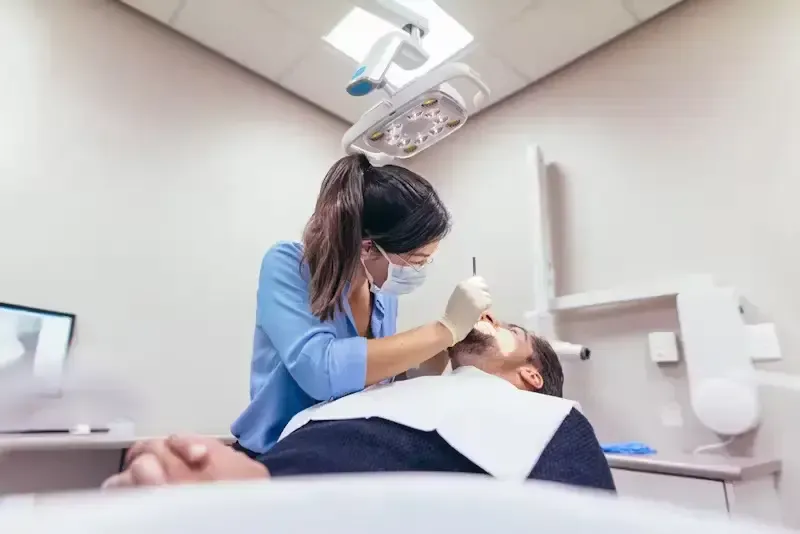

A surgical extraction removes a tooth that cannot simply be lifted out: one that has broken off at the gum line, is impacted in the bone, has curved or fused roots, or is too damaged to grip. At ConfiDental we perform surgical extractions in Beverly Hills with careful planning, thorough numbing and a calm pace, and we think about what replaces the tooth before we remove it. Most patients are surprised by how manageable it is.
We would always rather save a tooth than take it out. When extraction is the right call, our job is to do it gently, protect the bone around it and set you up for a smooth recovery.
Simple vs. surgical extraction
A simple extraction is used for a tooth that is fully visible and has straightforward roots. It is loosened and removed in one piece with instruments.
A surgical extraction is needed when that will not work. We may make a small opening in the gum, remove a little bone around the root, or divide the tooth into sections so each piece comes out without stressing the jaw or neighboring teeth. It sounds more involved than it feels. Done well, sectioning a tooth is often gentler than forcing it out whole.
When a surgical extraction may be needed
- A tooth broken off at or below the gum line, often after a broken tooth that could not be restored
- An impacted wisdom tooth trapped under the gum or bone
- Roots that are long, curved, hooked or fused to the bone
- A tooth with a vertical root fracture
- Severe decay or infection that leaves too little tooth to repair
- A previous root canal tooth that has failed and cannot be retreated
- Advanced gum disease with too little bone left to support the tooth
If a tooth is infected, we will often weigh extraction against root canal therapy first. Our article on root canal vs. tooth extraction explains how we decide.
How we plan surgical extractions in Beverly Hills
Good extractions are planned, not improvised. Before the day, we:
- Image the tooth X-rays show the roots and nearby structures. For impacted teeth or teeth near the sinus or the nerve in the lower jaw, a 3D scan gives us a clearer view.
- Review your health Blood thinners, diabetes, bisphosphonate medications and some heart conditions change how we prepare, so we go through your medications carefully.
- Talk through the replacement If the tooth is visible or important for chewing, we plan what comes next: an implant, a bridge or simply letting the area heal.
- Give you a written plan You get an itemized estimate covering the extraction and any grafting, with your expected insurance coverage.
What happens on the day
- Numbing We numb the tooth and surrounding tissue with local anesthetic and confirm it is fully numb before we begin. You will feel pressure, not sharp pain.
- Access If needed, a small flap of gum is gently moved aside to see the tooth and bone.
- Removal The tooth is loosened, and sectioned if that is the gentler route, then removed piece by piece.
- Cleaning the socket Any infected tissue is removed and the socket is rinsed.
- Preserving bone, if planned When an implant is likely, we may place a bone graft in the socket to help keep its shape.
- Closing A few stitches hold the gum in place. Many are the dissolving type.
Most surgical extractions take between 20 and 60 minutes, depending on the tooth. We explain what we are doing as we go, unless you would rather we did not. Before you leave, we go over aftercare in person, give it to you in writing and make sure you have gauze and know exactly whom to call.
Is a surgical extraction painful?
The procedure itself should not hurt once you are numb. The pressure can feel strange, and you may hear sounds that seem worse than they are. We check in often and pause whenever you need.
Afterward, soreness usually peaks in the first two to three days and then improves steadily. Most people manage with over-the-counter ibuprofen and acetaminophen, if those are safe for them. We give you clear written instructions and a number to call, (818) 875-5417 after hours, if something does not feel right.
Recovery: the first week
The first 24 hours
- Bite gently on gauze for 30 to 60 minutes to help a clot form.
- Use an ice pack on the cheek, 20 minutes on and 20 off, to limit swelling.
- Do not spit, rinse hard, smoke or drink through a straw. All of these can dislodge the clot.
- Eat soft, cool foods and keep your head slightly raised when resting.
Days two to seven
- Start gentle warm salt-water rinses after meals.
- Brush normally, carefully around the site.
- Expect some swelling and bruising, which usually peak around day two or three.
- Return to normal foods gradually as comfort allows.
Call us if pain gets sharply worse after day three, if you notice a bad taste with an empty-looking socket, or if swelling keeps growing. These can be signs of dry socket or infection. Our guide on how to tell if you have dry socket explains the difference between normal healing and a problem.
Possible complications
Most surgical extractions heal without trouble, but it is worth knowing the risks before you agree to one. Dry socket, where the blood clot is lost and the bone underneath is exposed, is the most common problem. It is painful but treatable. Infection, bleeding that lasts longer than expected and damage to a filling or crown on the next tooth can also happen.
Lower back teeth can sit close to the nerve that gives feeling to the lip and chin. In rare cases removal bruises it, and the area stays numb for weeks or, very rarely, longer. Upper back teeth can sit close to the sinus. Your X-rays or 3D scan show how near these structures are, and we talk through your own risk before the day.
Replacing the tooth afterward
Unless it is a wisdom tooth, a missing tooth usually needs replacing. Neighboring teeth drift into the gap, the opposing tooth can over-erupt, and the bone where the root used to be slowly shrinks.
The most common choice is a dental implant, which replaces the root and helps keep the bone. A bridge is another option. In some cases an implant can be placed at the time of extraction, but often the site needs a few months to heal first. Dr. Massaband has completed more than 1,500 implant procedures, so the extraction is planned with the implant in mind from the start.
Cost and insurance
The cost of a surgical extraction depends on the tooth, how impacted or broken it is, whether a bone graft is placed, and what imaging is needed. You get a written estimate before treatment. Most PPO plans cover extractions under basic or oral surgery benefits; read more on our dental insurance page, or ask about CareCredit through our payment options.
Who performs your extraction
Dr. Liyan Massaband has more than 15 years of experience and focuses on implants, full-mouth restoration and complex cases. When a case is better handled by an oral surgeon, such as a deeply impacted tooth very close to a nerve, we say so and coordinate the referral.
Our office is at 9615 Brighton Way, Suite 222, a short drive from Century City and Beverly Grove. Call (310) 858-9212 or book an extraction consultation online.