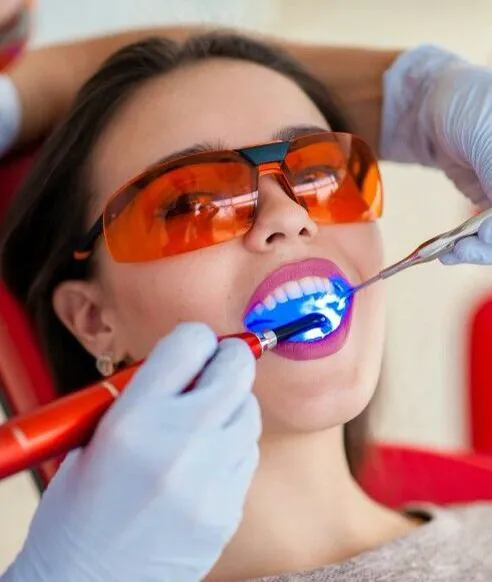

Laser dentistry uses a concentrated beam of light to treat gums and, in some cases, teeth with more precision and less bleeding than a scalpel or drill. At ConfiDental we offer laser dentistry in Beverly Hills for gum disease, gum contouring, frenectomies, crown lengthening and some cavities. For the right procedure, it usually means less swelling, fewer or no stitches and a quicker return to normal.
We use the laser when it gives you a better result or an easier recovery, not because it is new. For some treatments, conventional instruments are still the better tool, and we will tell you which applies to you.
What is laser dentistry?
A dental laser delivers energy at a specific wavelength that is absorbed by a particular kind of tissue. Some wavelengths are taken up mainly by water and pigment in soft tissue, which makes them suited to gum procedures. Others interact with the water in enamel and dentin and can remove decay. In both cases the laser lets us remove or reshape tissue in a very controlled way.
Because the laser seals small blood vessels and nerve endings as it works, soft tissue procedures tend to bleed less and feel less sore afterward. It also reduces bacteria in the area it touches, which is useful when treating infected gum pockets.
Benefits, and where lasers are not the right tool
For suitable procedures, patients usually notice:
- Less bleeding, since the laser seals tissue as it works
- Less swelling and soreness after soft tissue treatment
- Fewer or no stitches for many gum procedures
- Precise margins, which matters for cosmetic gum work around front teeth
- Often less anesthetic, especially for small soft tissue procedures
- No drill vibration for some cavity treatments
There are limits. Lasers cannot remove old metal fillings or prepare a tooth for a crown, and large or deep cavities are still treated more efficiently with conventional instruments. Complex extractions and extensive bone surgery are also better done the traditional way. Often the best plan combines both.
Laser dentistry treatments we offer
Laser gum disease treatment
For gum disease, the laser is used alongside thorough cleaning of the roots. After scaling and root planing remove tartar, the laser treats the lining of the pocket, reduces bacteria and helps the gum seal against the tooth. Our laser gum therapy page explains the process in more detail. For moderate to advanced cases we also offer LANAP, the Laser-Assisted New Attachment Procedure, a specific laser protocol designed to treat deep pockets without cutting the gum or placing stitches.
Laser-assisted deep cleaning
For early to moderate gum disease, laser decontamination can be added to a standard deep dental cleaning. It is not a substitute for cleaning the roots properly. It is an extra step that helps the tissue respond.
Gum contouring
Gums that cover too much of the tooth, or sit unevenly, can make healthy teeth look short or lopsided. The laser removes small amounts of gum tissue to even out the gum line in one visit, usually with no stitches. When contouring is part of porcelain veneers or a smile makeover, we do it first so the final teeth are designed around the new gum line.
Crown lengthening
When a tooth has broken or decayed below the gum line, there may not be enough tooth showing to hold a crown securely. Crown lengthening exposes more tooth. For soft tissue cases the laser can do this with less bleeding and quicker healing, giving a clean margin for the porcelain crown that follows. If bone needs to be reshaped too, we may combine techniques.
Frenectomy
A frenum is the small fold of tissue linking the lip or tongue to the gums or floor of the mouth. When it is tight, it can pull on the gums, hold a gap open between front teeth or limit tongue movement. A laser frenectomy releases it quickly, usually without stitches, and healing takes days.
Oral sores and soft tissue lesions
The laser can ease painful canker sores and help remove small benign growths with minimal bleeding. Anything suspicious is sent for biopsy so we know exactly what it is.
Laser cavity treatment
For small cavities, a hard tissue laser can remove decay without the vibration of a drill, and some patients need little or no numbing. The tooth is then restored with a tooth-colored filling. Larger cavities are usually better treated conventionally.
Laser vs. traditional methods
| Factor | Laser | Traditional |
|---|---|---|
| Bleeding | Minimal for soft tissue work | More, often needs pressure or stitches |
| Swelling afterward | Usually mild | More common after gum procedures |
| Stitches | Often none | Often needed for soft tissue surgery |
| Anesthetic | Sometimes less, especially for small procedures | Usually local anesthetic |
| Noise and vibration | Little or none | Drill noise and vibration |
| Best suited to | Gum procedures, frenectomy, small cavities | Large cavities, crowns, removing old fillings, complex surgery |
Is laser dentistry in Beverly Hills right for you?
Laser treatment tends to suit people who:
- Feel anxious about drills, scalpels or stitches
- Have gum disease and want to avoid or delay conventional gum surgery
- Want a more even gum line as part of cosmetic work
- Need a frenectomy for orthodontic, speech or gum reasons
- Have had a slow recovery from gum procedures before
We decide case by case at your consultation, based on the tissue involved, how extensive the treatment is and what will heal best.
What to expect at your appointment
Before
We examine the area, explain why we are suggesting the laser and what the healing will look like, and give you a written estimate.
During
Everyone in the room wears protective glasses. Depending on the procedure, we use topical gel, a small amount of local anesthetic, or both, and you can always ask for more numbing. You may notice a light snapping sound or a faint smell as the laser works. Small procedures take 15 to 30 minutes; gum treatment across several areas can take 60 to 90 minutes.
After
Most soft tissue procedures leave mild soreness for a day or two. Treated gums can look white or grey for a few days as they heal, which is normal. Eat soft foods, rinse gently with salt water and avoid very hot or spicy food until the area settles. For gum disease treatment, the tissue continues to heal and tighten over the following weeks, and we see you to check progress.
Cost and insurance
Typical ranges at our office are about $200 to $400 for laser cavity treatment, $300 to $600 per arch for gum contouring, and $1,500 to $4,000 per quadrant for LANAP periodontal therapy. Your estimate depends on how much is treated.
Medically necessary procedures are often covered under the same benefit as the conventional version: a laser filling under your filling benefit, gum disease treatment under your periodontal benefit. Purely cosmetic contouring usually is not covered. Our dental insurance page explains more, and CareCredit financing is available.
Your dentist
Dr. Liyan Massaband has more than 15 years of experience and a strong interest in minimally invasive care: treat what needs treating and leave healthy tissue alone. Patients come to our Brighton Way office from Bel Air, Beverly Grove and across the Westside. Call (310) 858-9212 or book a visit online to ask whether laser treatment fits your case.