
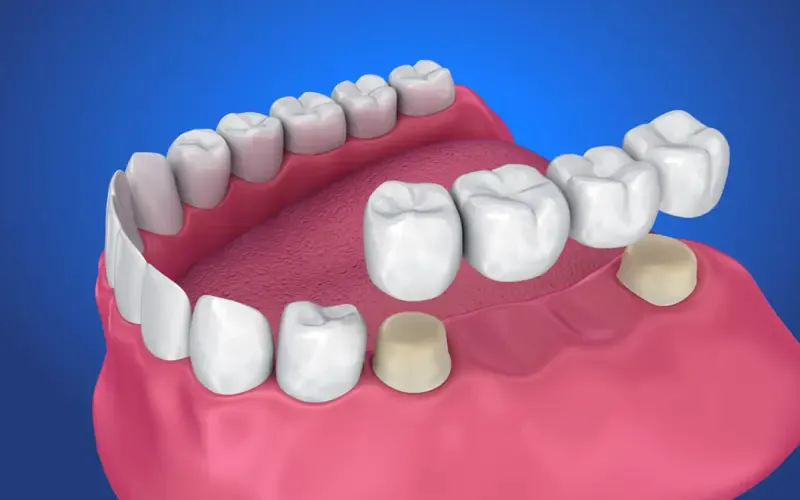

A dental bridge replaces one or more missing teeth with a fixed restoration: a natural-looking replacement tooth held in place by crowns on the teeth, or implants, on either side of the gap. At ConfiDental we design dental bridges in Beverly Hills to restore chewing, speech and the shape of your smile, and to keep the surrounding teeth from drifting into the space. Before recommending one, we compare it honestly with an implant, so you choose with the full picture.
Unlike a partial denture, a bridge does not come out. You brush it, floss under it and chew on it like your own teeth.
How a dental bridge works
A traditional bridge has three or more units made as one piece:
- Abutments. Crowns that fit over the teeth on each side of the gap, or over dental implants. They anchor the bridge.
- Pontic. The replacement tooth that sits in the gap, shaped to rest gently on the gum so it looks as if it grows from there.
The pontic is matched to the shape, size and shade of the tooth it replaces. When the bridge is cemented, the whole unit acts as one, sharing biting forces across the anchor teeth.
Why replace a missing tooth at all?
A gap can seem harmless, especially toward the back. Over time, though:
- Neighboring teeth tip and drift into the space, opening gaps elsewhere and trapping food
- The opposing tooth can grow down or up into the gap
- Your bite shifts, which can strain other teeth and the jaw
- Chewing moves to one side
- A missing front tooth affects speech and confidence
Replacing the tooth stops that chain of changes before it starts.
Types of bridges
Traditional bridge
Crowns on the natural teeth on both sides support the replacement tooth. It is the most common design and is very strong, but it means reshaping the anchor teeth for crowns. It makes most sense when those teeth already have large fillings or need crowns anyway.
Implant-supported bridge
When several teeth in a row are missing, two or more implants can support a bridge without involving natural teeth at all. Our implant restoration page explains how the final teeth are made.
Cantilever bridge
Anchored on one side only. It can work in specific, low-force situations, usually at the front of the mouth, but it is used selectively.
Bonded (Maryland) bridge
A replacement tooth with small wings bonded to the backs of the neighboring teeth. Very little tooth is removed, which makes it a conservative option for a single front tooth, though it is less strong than a traditional bridge.
Bridge or implant?
| Dental bridge | Single dental implant | |
|---|---|---|
| Neighboring teeth | Usually reshaped to hold crowns | Left untouched |
| Jawbone | Bone under the gap can shrink over time | The implant helps keep the bone |
| Treatment time | About two to three weeks | Usually several months including healing |
| Surgery | None | A minor surgical procedure |
| Cleaning | Floss threader or water flosser under the pontic | Brush and floss like a natural tooth |
| Best when | Neighbors already need crowns, or surgery is not suitable | Neighbors are healthy and bone is adequate |
Neither is right for everyone. If the teeth beside the gap are healthy and untouched, an implant usually protects them better. If they already carry large fillings or crowns, a bridge can restore them and replace the missing tooth in one step. Dr. Massaband has completed more than 1,500 implant procedures, so we can talk through both options in real detail.
Are you a good candidate for dental bridges in Beverly Hills?
A bridge tends to suit you if:
- You are missing one tooth, or a few teeth next to each other
- The anchor teeth are strong, with healthy roots and good bone support
- Your gums are healthy, or any gum disease is treated first
- You are prepared to clean carefully under the bridge every day
Heavy grinding, very short anchor teeth or significant bone loss may point toward a different solution.
The process at our office
- Exam and planning We examine the gap and the anchor teeth, take X-rays and scans, and discuss the options side by side. You get an itemized, written plan with your expected insurance coverage.
- Preparing the anchor teeth Under local anesthetic, the teeth on either side are shaped to receive crowns.
- Scan and temporary bridge A digital scan goes to the dental lab, and a temporary bridge protects the teeth and fills the gap while the final one is made, usually one to two weeks.
- Fitting We check the fit, the shade, how the pontic meets the gum and how your bite feels, then cement the bridge.
- Follow-up A short check a week or two later confirms comfort and shows you how to clean under the bridge.
Preparation is done with the teeth numb, so you should feel pressure rather than pain. Mild sensitivity for a few days afterward is common, and it usually fades once the final bridge is cemented and the tooth surfaces are sealed again.
Caring for your bridge
The area under the pontic is where problems start, because food and plaque collect there and toothbrush bristles do not reach. Each day:
- Brush twice, angling the brush toward the gum line around the anchor crowns.
- Clean under the pontic with a floss threader, super floss or a water flosser.
- Keep regular cleanings and exams, so we can check the edges of the crowns for decay.
If you grind, a night guard protects the porcelain.
How long do dental bridges last?
With good daily care and regular checkups, a bridge commonly lasts seven to ten years, and often longer. The most common reasons a bridge fails are decay at the edge of an anchor crown and gum disease around the anchor teeth, both of which are largely preventable. Our article on how long dental bridges last covers this in more depth.
Cost and insurance
The cost of a bridge depends mostly on the number of units (each anchor crown and each replacement tooth counts as one), the material, and whether any preparatory work is needed. You receive a written estimate before treatment. Most PPO plans cover a portion of bridges under major services; our dental insurance page explains how those benefits work, and CareCredit financing is available.
Your dentist
Dr. Liyan Massaband has more than 15 years of restorative experience, including complex cases and full-mouth restoration. Patients come to our Brighton Way office from Beverly Grove, Westwood and across Los Angeles. If you would like to know what to expect before you book, read what to expect with dental bridges, call (310) 858-9212 or book a bridge consultation online.