
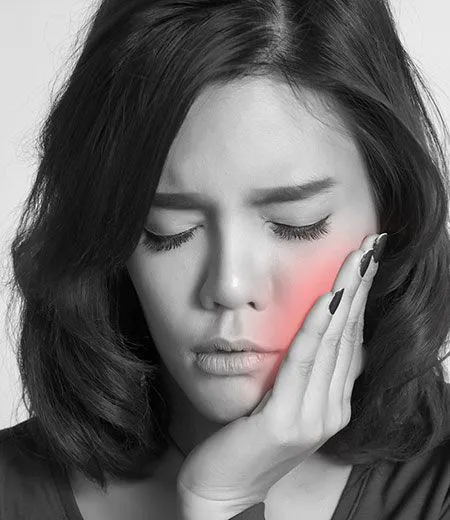

TMJ treatment in Beverly Hills at ConfiDental starts by working out where your jaw pain actually comes from: the jaw joint, the chewing muscles, or a tooth. Dr. Liyan Massaband checks how your jaw opens, clicks and moves, then begins with gentle, reversible care such as a self-care plan, a custom night guard and jaw exercises. Most people improve with these steps. When symptoms need more, we refer you to an orofacial pain specialist or oral surgeon.
If you wake with a sore jaw, hear clicking when you open your mouth, get morning headaches or ear pain with no clear cause, or have been told you grind your teeth at night, an evaluation is the sensible first step.
What is TMJ disorder?
Your temporomandibular joint is the hinge in front of each ear that connects your lower jaw to your skull. A small disc of cartilage inside lets the jaw glide smoothly when you talk, chew and yawn.
TMJ disorder, or TMD, is a group of problems with that joint and the muscles that move it. According to the National Institute of Dental and Craniofacial Research, TMD affects about 5 percent of U.S. adults and is about twice as common in women. For many people it is temporary and settles with simple care.
TMJ problems usually fall into three groups, and many people have more than one:
- Muscle pain: tight, sore chewing muscles, the most common type. Our page on jaw fascia pain covers it in detail.
- Joint problems: the disc slips out of place, causing clicking, popping or locking.
- Arthritis: wear or inflammation inside the joint, with stiffness and a grating feeling.
TMJ symptoms
- Aching or tenderness in the jaw, in front of the ear or at the temples
- Clicking, popping or grating when you open or close
- A jaw that catches, or locks open or shut
- Difficulty opening wide, or a jaw that drifts to one side as it opens
- Headaches, especially in the morning or at the temples
- Ear pain, fullness or ringing with no ear infection
- Pain when chewing, yawning or talking for a long time
- Worn, chipped or sensitive teeth from clenching and grinding
- Neck and shoulder tension
Clicking on its own, without pain or locking, is common and often needs no treatment. If your pain is only on one side, our article on why the jaw hurts on one side explains the usual causes.
Is it the joint, the muscles or a tooth?
| Source | How it often feels | Common clues |
|---|---|---|
| Jaw joint | Pain right in front of the ear | Clicking, popping, catching or locking |
| Jaw muscles | Dull, tight ache in the cheeks or temples | Worse in the morning, linked to clenching or stress |
| A tooth | Sharp or throbbing pain in one tooth | Pain to hot, cold or biting |
| Wisdom tooth | Ache at the back of the jaw | Swollen gum, bad taste |
| Ear, sinus or nerve | Pain that does not change with jaw movement | Fever, blocked ear or facial numbness; needs a physician |
This is why the exam matters. Treating a tooth infection with a night guard, or a tight muscle with a root canal, helps no one.
What causes TMJ problems?
The cause is often a combination rather than one thing. Common contributors:
- Clenching and grinding, at night or during the day
- Stress, anxiety and poor sleep, which make clenching worse
- Disc displacement inside the joint
- Arthritis, such as osteoarthritis or rheumatoid arthritis
- Injury from a blow to the jaw, a fall or whiplash
- Habits like gum chewing, nail biting or resting your chin on your hand
- Long dental visits or very wide yawns that strain an already sore joint
You may have heard that a "bad bite" causes TMJ. Research does not support the idea that a bad bite or braces cause TMD.
How we treat TMJ, step by step
We start with conservative, reversible treatment and move on only if you need to.
1. A thorough evaluation
We examine your jaw joints, muscles, bite and teeth, measure how wide you can open, listen and feel for clicking, and press on the muscles to find tender points. X-rays rule out a tooth problem when needed. We also ask about clenching, sleep, stress and headaches, because those usually explain the pattern.
2. A self-care plan
Most people improve with simple daily changes, described in the home care section below. We go through them with you rather than handing over a leaflet.
3. A custom night guard
A custom night guard, or stabilization splint, covers your teeth at night, reduces clenching force and protects teeth from grinding. It does not permanently change your bite. Many people notice less morning jaw pain within two to six weeks.
4. Jaw exercises, massage and physical therapy
Gentle stretching, posture work and massage of the cheek and temple muscles can ease pain and improve opening. For stubborn cases, we refer you to a physical therapist who treats jaws.
5. Medication
Short courses of over-the-counter anti-inflammatory pain relievers can help, if they are safe for you. Muscle relaxants and other prescriptions come from your physician.
6. Botox for clenching-related muscle pain
Botox injected into the jaw muscles can relax them and reduce clenching force for a few months at a time. It is not FDA-approved for TMD and study results are mixed, so we discuss it honestly as an option for muscle pain from clenching, not a cure for joint problems.
7. Referral when you need more
If your jaw stays locked, the joint is badly damaged, or pain continues despite treatment, we refer you to an orofacial pain specialist or an oral and maxillofacial surgeon. Surgery is rarely needed and is considered only for severe, long-lasting problems.
What we do not recommend for TMJ
- Grinding down teeth to "balance" the bite
- Braces or Invisalign as a TMJ cure
- Crowns or other permanent bite changes done only to treat TMJ
There is not enough evidence that these help TMD, and they can sometimes make it worse. Straightening teeth is still worthwhile for its own reasons, just not as a TMJ treatment.
TMJ relief at home
- Rest your jaw: soft foods cut into small pieces during a flare-up
- Heat or cold: a warm compress for tight muscles, a cold pack for ten minutes for sharp joint pain
- Lips together, teeth apart: your teeth should only touch when you chew or swallow
- Gentle stretches: open slowly within a comfortable range a few times a day
- Skip gum and wide yawns, and support your chin when you yawn
- Watch your posture: keep your head over your shoulders at the phone or laptop
- Wind down before bed: stress and poor sleep both increase clenching
If you snore loudly or wake up tired, tell us. Grinding is often linked to disturbed sleep, and a sleep check or a snoring appliance may be more useful than a standard night guard.
TMJ treatment cost in Beverly Hills
| Treatment | Approximate cost | Insurance |
|---|---|---|
| TMJ evaluation and consultation | $150 to $300 | Often covered as a diagnostic visit |
| Custom night guard or occlusal splint | $300 to $800 | Partly covered by many dental plans |
| Botox for jaw muscles, per session | $500 to $1,200 | Some medical plans cover it for diagnosed bruxism |
You get a full cost breakdown at your consultation before any treatment begins. We review both dental and medical benefits, since some TMJ care can qualify under either. Our payment options page explains CareCredit financing.
Results and what to expect over time
Most TMJ problems improve with conservative care, often noticeably within a few weeks, though flare-ups can return during stressful periods. A night guard tends to last several years with care and should come to your checkups so we can confirm it still fits evenly. If you are not improving, we change the plan or refer you, rather than repeating what is not working.
Dr. Massaband takes a careful, step-by-step approach: she listens to your full history, starts with the simplest care that works, and coordinates with physical therapists, physicians and orofacial pain specialists when that is the better path. Patients come to us from Beverly Hills, Century City and Brentwood. Call (310) 858-9212 or book a TMJ consultation online.